The Celtic Cross Tarot Spread: How to Read All 10 Positions
Tommy Sherma
8/25/2026
The Celtic Cross is a ten-card tarot spread that examines a question from its hidden roots to its likely harvest, making it ideal when three-card readings feel too shallow. For over a century, readers have relied on this layout to reveal what simpler spreads cannot. This guide teaches all ten positions in plain language, the pairing technique professionals use, and the classic mistakes to avoid.
What Is the Celtic Cross?
The Celtic Cross is a ten-card spread arranged in two shapes: a cross of six cards beside a staff of four. Together they examine one question in full dimension — what is happening beneath your awareness, what surrounds you, what you bring to the situation, and where it is most likely heading.
It is the oldest formally recorded spread in tarot. A. E. Waite — co-creator of the Rider-Waite-Smith deck — published it in The Pictorial Key to the Tarot in 1911, calling it "the most convenient method." Whatever its true age, it has remained the signature spread of serious tarot practice ever since.
Why does it endure? Depth with structure. A single card gives you a headline. Three cards give you a sentence. The Celtic Cross gives you the full paragraph — with a built-in grammar that keeps a reading specific when ten free-floating cards would dissolve into vagueness.
The Layout: Two Shapes, One Story
Before memorizing positions, understand the architecture. The two shapes answer different kinds of questions:
- The Cross (positions 1–6) is the landscape of your question — your center, the force crossing you, the root below, the ideal above, the past behind, the future ahead.
- The Staff (positions 7–10) is the journey through that landscape — your approach, your environment, your inner hopes and fears, and the destination the energy flows toward.
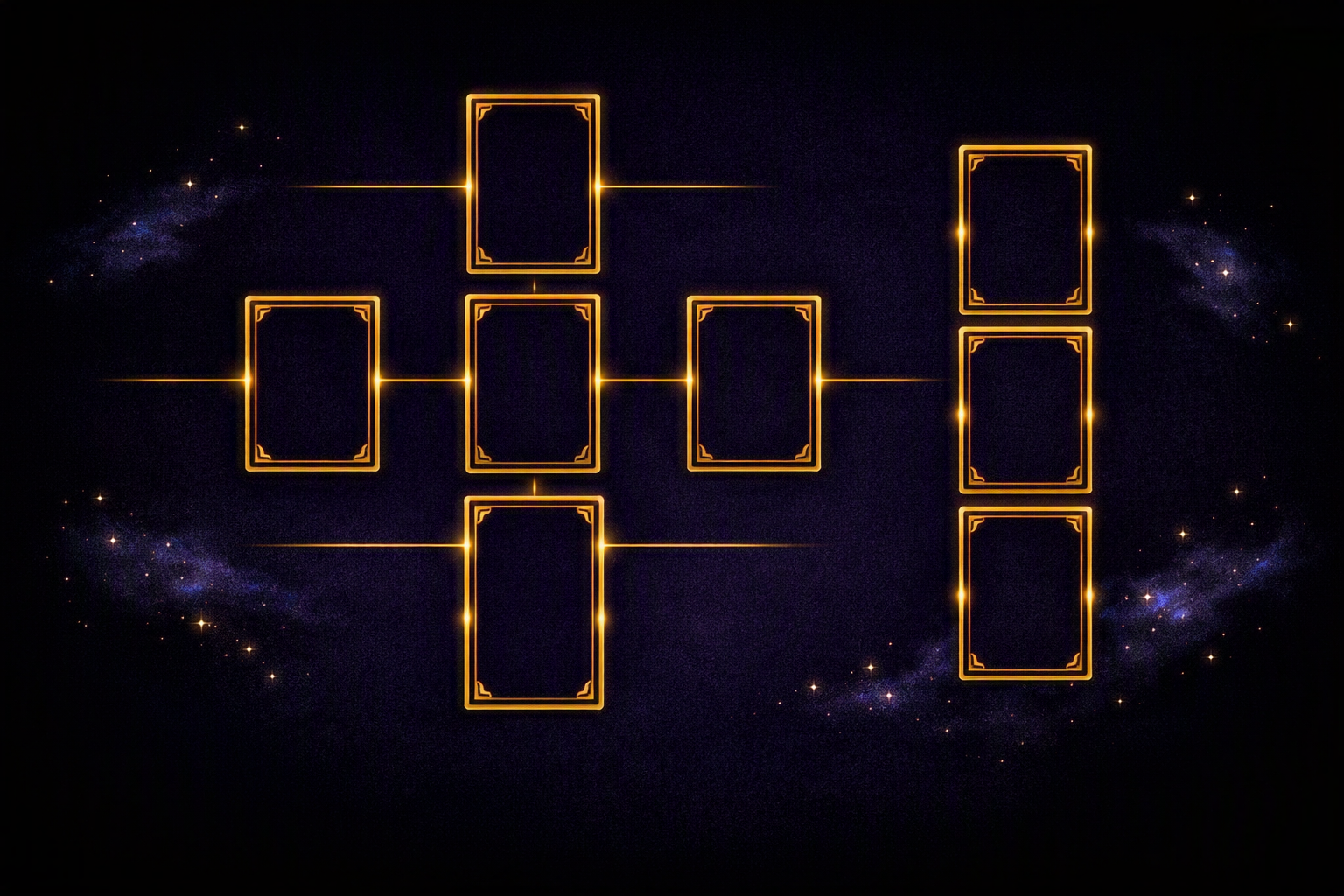
| # | Position | In plain words |
|---|---|---|
| 1 | The Heart of the Matter | The core of the situation |
| 2 | The Crossing Card | What challenges or supports it |
| 3 | The Foundation | The hidden root beneath it |
| 4 | The Recent Past | What is just now receding |
| 5 | The Crown | The conscious goal or ideal |
| 6 | The Near Future | What is approaching |
| 7 | Your Approach | How you are showing up |
| 8 | External Influences | Other people and environment |
| 9 | Hopes and Fears | What you desire and dread |
| 10 | The Outcome | Where the current energy leads |
Read the cross first, then the staff. Beginners often read 1 → 2 → 3 in strict sequence, like a list. Experienced readers read it as a scene: the past (4) flows into the heart (1), which pushes toward the future (6), while the foundation (3) feeds it from below and the crown (5) pulls it from above.
Position by Position: What Each Card Reveals
Position 1 — The Heart of the Matter. The card laid first, at the center. It names the situation's essential energy. This is not "you" — it is the matter itself. A Two of Swords here means the real issue is a stalemate, whatever your question was.
Position 2 — The Crossing Card. Laid across the first, rotated 90°. It is the force that meets the heart of the matter: an obstacle, an ally, or a complication. A supportive card here (The Star, Six of Cups) means the challenge itself carries a gift. A heavy card (The Tower, Ten of Swords) means the friction is real — and named.
Position 3 — The Foundation. Below the heart. The subconscious root: old patterns, family imprinting, forgotten promises you made yourself. Often the most revealing card in the entire spread — the thing the querent is not seeing.
Position 4 — The Recent Past. To the left, in most layouts. What is receding but still shaping events. Not ancient history — the chapter that just closed, whose fingerprints are still on the present.
Position 5 — The Crown. Above the heart. The conscious aim: what you think you want, the ideal you are reaching toward. Watch position 5 against position 3 — when the crown and the foundation disagree, the inner conflict is the real situation.
Position 6 — The Near Future. To the right. What is approaching in the coming weeks — not the final result (that is position 10), but the next development already forming.
Position 7 — Your Approach. The first staff card. Your posture toward the situation: attitude, strategy, or blind spot. An honest card, this one — it describes you as you actually are, not as you intend to be.
Position 8 — External Influences. The environment: other people, workplace dynamics, family opinion, timing, luck. Position 7 is you; position 8 is everything that is not you.
Position 9 — Hopes and Fears. Often one feeling wearing two masks — what you most desire and most dread are frequently the same outcome. The Nine of Swords here does not mean nightmares; it means the fear is doing more damage than the feared thing ever could.
Position 10 — The Outcome. Where the current energy is flowing if nothing changes. This is the card beginners fear and professionals respect — because it is the most conditional card in the spread. It is a forecast of trajectory, not a sentence.
The Pairing Technique: How Professionals Actually Read It
Here is the secret that separates a fluent reading from ten separate card meanings: the Celtic Cross is designed to be read in pairs. The positions are not isolated slots — they are conversations.
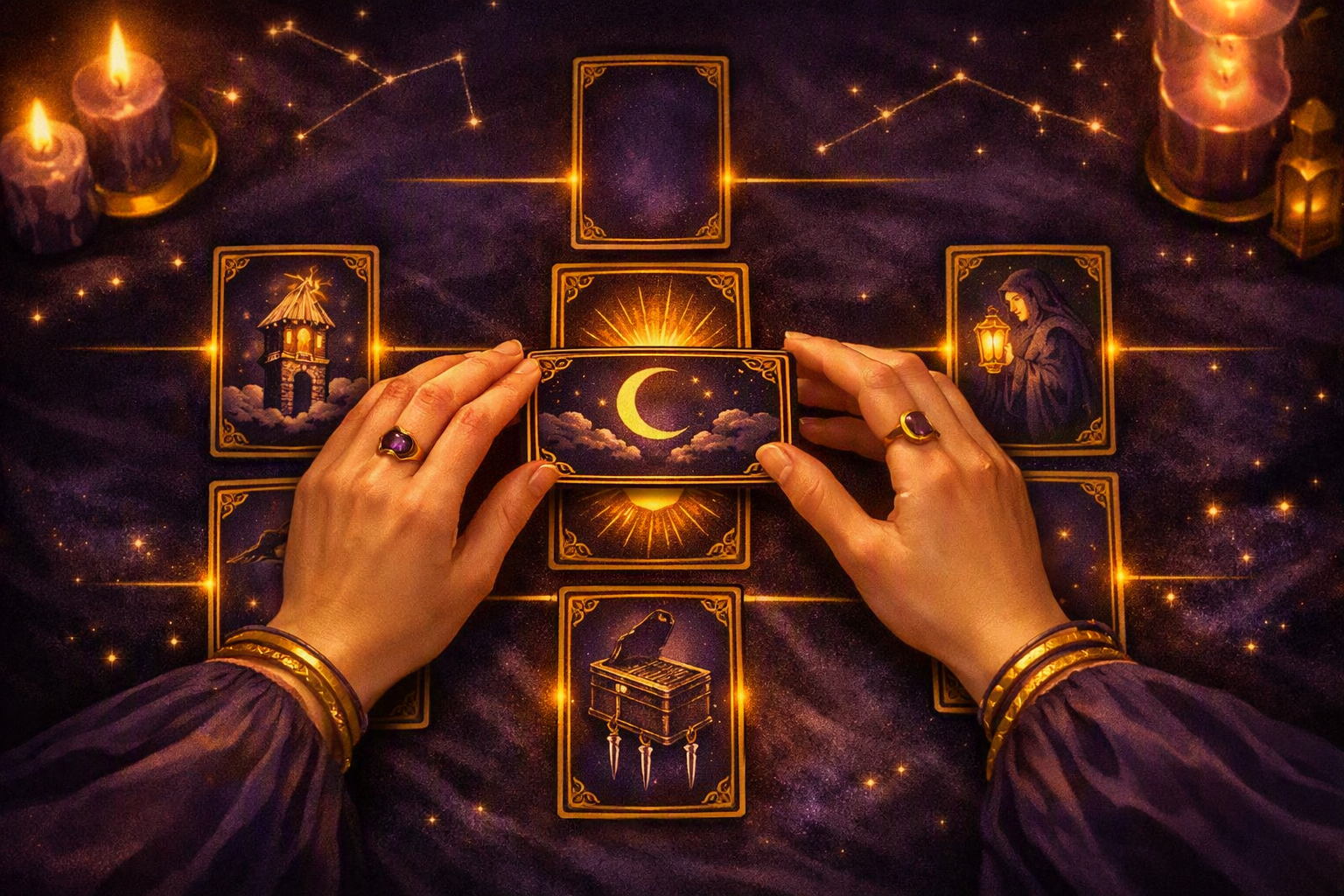
1 + 2 — The Situation and Its Friction. Read the heart and the crossing card together as one image. The Empress crossed by the Four of Pentacles: abundance is available, but a clenched grip is strangling it. The pair tells you what the reading is about.
3 + 5 — The Root and the Ideal. The foundation and the crown. When they harmonize, you are congruent — your conscious goal grows from your deep soil. When they contradict (a root of Eight of Cups under a crown of Ten of Pentacles), the reading has found its true question: whose life are you building?
4 + 6 — The Past and the Future. The timeline flanking the present. The same suit or number appearing in both means a pattern is repeating; escalating numbers mean momentum is building; a Major Arcana in position 6 means bigger forces are entering.
7 + 8 — You and the World. Your approach against your environment. Alignment here means the path is natural — your posture fits the terrain. Conflict (Seven of Wands in 7 with Ten of Wands in 8) means you are fighting your surroundings, and the reading should ask whether the fight is the point.
9 + 10 — The Desire and the Destination. The most powerful pair in the spread. When the outcome matches the hope, the path is open. When position 10 answers position 9's fear instead of its hope, the situation is heading toward the very thing being avoided — and that is exactly where a conscious choice can still change the story.
A full Celtic Cross reading is not ten interpretations. It is five conversations, read in order, telling one story.
A Worked Example
A question: "What do I need to understand about leaving my job to freelance?"
- 1 — Eight of Pentacles: The heart of the matter is dedicated craft — you have been quietly mastering the work itself.
- 2 — The Moon crossing it: Uncertainty and unstable income are the real friction, not lack of skill.
- 3 — Four of Pentacles at the foundation: A root belief that security comes only from a steady employer.
- 5 — The Star at the crown: The conscious ideal is finally doing work that feels like hope.
- 7 — Knight of Wands: Your approach is impulsive courage.
- 8 — Four of Cups in the environment: Your current workplace offers apathy, not opportunity.
- 9 — Two of Swords: Hopes and fears frozen in the same posture — the fear of choosing at all.
- 10 — Three of Pentacles: The trajectory, if nothing changes, is collaborative, self-made, recognized work.
Read the pairs and the story assembles itself: the root (security must come from an employer) is contradicting the crown (work as hope); the crossing fear (unstable income) is blocking a heart that is genuinely skilled; and the frozen 9 is the actual obstacle — not the market, not the boss. The outcome card is not a promise; it is a demonstration of where the energy flows the moment the Two of Swords finally sets down its swords.
That is a Celtic Cross working correctly: not fortune-telling, but a mirror held at ten angles.
When to Use the Celtic Cross (and When Not To)
The Celtic Cross is a deep instrument. Use it for genuine crossroads — career pivots, relationship decisions, creative blocks that keep repeating, "why does this pattern follow me" questions.
It is the wrong tool for lighter needs. A daily energy check needs one card; a weekly theme needs three. For the rhythm of daily divination — the kind that pairs beautifully with a morning horoscope — read our guide to daily cosmic forecasting and keep a lighter practice running alongside your deep readings.
And respect the weight: a Celtic Cross asks the deck for a full map. Doing three a day on the same question does not produce more truth — it produces noise. One thorough reading, honored with action, outweighs a dozen anxious ones.
Five Classic Mistakes to Avoid
- Reading ten cards as ten separate predictions. The pairs are the grammar. Without them, you get ten keywords instead of a story.
- Treating position 10 as fate. The outcome card describes the current trajectory. It is the most changeable card in the spread, not the least.
- Skipping the foundation (position 3). It is the subtlest and most revealing card — the root beneath the visible situation. Beginners skip it; professionals start there.
- Interpreting for someone who has not asked. The same ethics that apply to any tarot reading apply doubly to a spread this deep. No consent, no reading.
- Using it before you can read relations. If three-card spreads still feel shaky, the Celtic Cross will not fix that — it will amplify it. Depth multiplies whatever skill is present, including confusion.
Going Deeper: Pair the Spread with Your Birth Chart and Dreams
The Celtic Cross maps the present. Two other lenses map the permanent and the subconscious — and readers who combine all three consistently report the sharpest self-portraits.
Your birth chart is the territory: the lasting inclinations the cards keep bumping into. When the same foundation card appears in reading after reading, an astrological root is often underneath it — which is exactly why position 3 rewards attention. Start with our complete beginner's guide to birth charts to learn your Big Three, then watch which cards your chart "attracts."
Your dreams are the nightly Celtic Cross — the subconscious (position 3) speaking unsolicited. Keep a dream journal beside your tarot journal, and the overlap becomes uncanny: the imagery your sleeping mind produces often names the same root your spreads keep finding. Our dream interpretation guide covers the common symbols and how to decode them.
Three languages, one conversation: the chart describes the terrain, the dream describes the weather beneath it, and the Celtic Cross describes where you are standing today.
How to Get a Celtic Cross Reading
Reading a Celtic Cross fluently takes months of practice — the pairing technique alone is a skill. The faster path is a guided reading that lays out all ten positions for you and walks through each pair in plain language.
With an AI-powered tarot reading you can choose the Celtic Cross spread, hold your question, and receive the full ten-card interpretation — positions explained, pairs connected, and the story between the cards told in your own language.
Final Thoughts
The Celtic Cross has outlived every trend in tarot for one reason: it works. Ten positions, five conversations, one story — a mirror held at ten angles to a single question.
Learn the pairs before the meanings. Start at the foundation before the outcome. And when the spread shows you a pattern you already half-knew, do not reshuffle — act.
The question you have been carrying deserves the full ten cards. Lay out your Celtic Cross reading →
Try It Yourself
Shuffle a virtual deck and draw 1, 3 or 5 cards with instant meanings.
Try It Free →