How to Read Tarot Cards: A Complete Beginner's Guide
Tommy Sherma
8/2/2026
To read tarot cards, you interpret the 78-card deck as a mirror of your life's patterns, choices, and energies rather than a fixed future. Start by learning the Major and Minor Arcana, then practice simple spreads that reveal the story beneath your question. This beginner's guide builds your confidence step by step.
What Is Tarot, Really?
Tarot is a deck of 78 illustrated cards used for divination, self-reflection, and intuitive guidance. Each card carries symbolic imagery drawn from centuries of esoteric tradition — astrology, numerology, elemental symbolism, and archetypal psychology.
A common misconception is that tarot tells your fortune. In practice, a tarot reading maps the energies currently surrounding a situation so you can make a more conscious choice. The cards do not remove your agency — they clarify it.
When you learn how to read tarot cards, you are really learning a symbolic language. Once the vocabulary clicks, the deck becomes a tool you can use for daily reflection, decision-making, and creative insight.
The Structure of the Tarot Deck
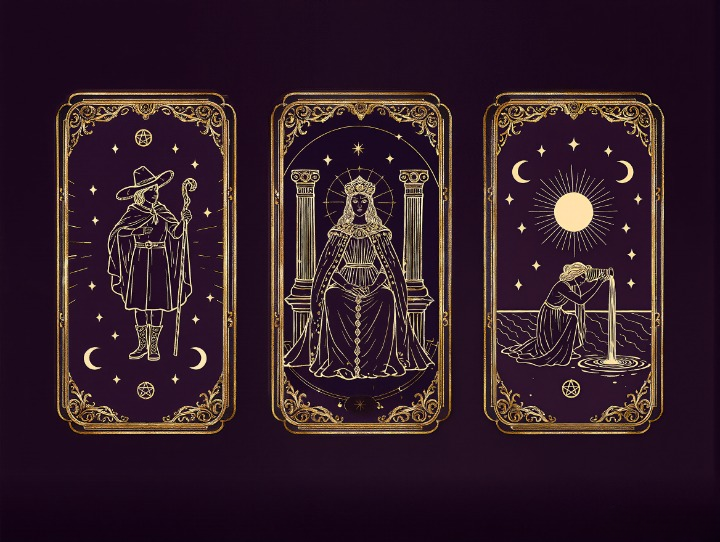
Every traditional tarot deck (Rider-Waite-Smith and its descendants) is divided into two main sections: the Major Arcana and the Minor Arcana. Understanding this split is the foundation of every reading.
The Major Arcana — Life's Big Arc
The Major Arcana consists of 22 cards, numbered 0 (The Fool) through 21 (The World). These cards represent major life themes, spiritual lessons, and pivotal turning points.
When a reading is heavy with Major Arcana cards, the situation is significant — something larger is at play, often outside your immediate control.
Some of the most recognizable Major Arcana cards include:
- The Fool (0) — new beginnings, innocent leaps, risk
- The Magician (1) — manifestation, willpower, resources at hand
- The High Priestess (2) — intuition, the subconscious, hidden knowledge
- The Lovers (6) — choice, values, partnership
- The Wheel of Fortune (10) — cycles, turning points, fate
- The Tower (16) — sudden upheaval, revelation, false structures falling
- The Star (17) — hope, healing, renewal after crisis
- The World (21) — completion, integration, a chapter fulfilled
The Minor Arcana — The Texture of Daily Life
The remaining 56 cards form the Minor Arcana. They reflect the everyday situations, emotions, conflicts, and actions that fill the spaces between major life events.
The Minor Arcana is divided into four suits, each tied to an element:
- Cups (Water) — emotions, relationships, intuition
- Pentacles (Earth) — money, work, body, material reality
- Swords (Air) — thoughts, conflict, communication, decisions
- Wands (Fire) — passion, creativity, ambition, drive
Each suit runs from Ace through 10, plus four Court Cards: Page, Knight, Queen, and King. Court cards often represent people in your life — or aspects of your own personality.
Quick tip: When you are just starting to learn tarot card meanings, focus on the Aces and the numbered cards first. Court cards are nuanced and easier to internalize once the suit's core energy is familiar. The Minor Arcana guide covers every card in each suit in detail.
How to Read Tarot Cards: A Step-by-Step Process
The actual act of reading tarot is simpler than most beginners expect. The skill is not in memorizing 78 definitions — it is in connecting cards into a coherent story.
Step 1: Hold a Clear Question
Before you draw a single card, settle your question. Vague questions produce vague readings.
- Weak: "Will I be happy?"
- Stronger: "What do I need to understand about my current career path?"
A good tarot question is specific enough to guide interpretation, but open enough to let the cards surprise you.
Step 2: Shuffle With Intention
There is no correct way to shuffle. Some readers riffle; others pile and reassemble. What matters is focus — let your question stay in your mind as you shuffle, and stop when the deck feels ready.
Step 3: Cut the Deck
Traditionally, the querent (the person asking) cuts the deck into three piles with their left hand, then stacks them back in a different order. This is optional, but it adds a moment of ritual intention.
Step 4: Lay Out Your Spread
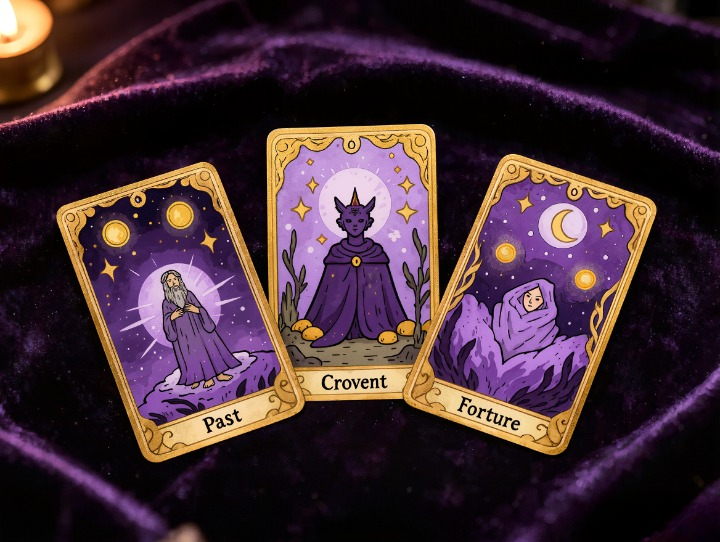
A spread is a predefined layout where each position has a meaning. The position a card lands in shapes how you interpret it. For example, in a past–present–future spread, the same card means something different in each slot.
Step 5: Read the Story, Not Just the Cards
Beginners often flip cards one at a time and interpret each in isolation. A stronger approach is to lay them all down, then read the relationships between them:
- Do the cards move from low numbers to high? The situation is building.
- Are multiple cards from the same suit? That element is dominant.
- Do any figures in the artwork appear to look at each other? There is a connection.
- Is there a repeating number across suits? Numerology is at play.
The story is always more accurate than any single keyword.
Essential Tarot Spreads for Beginners
You do not need to know dozens of spreads to read tarot well. Three foundational spreads will carry you through most questions.
1. The Single Card Pull
Draw one card. That's it. Ideal for daily check-ins, quick clarity, or learning the deck one card at a time.
Example question: "What energy should I embody today?"
2. The Three-Card Spread
The most versatile spread in tarot. Three cards, three positions, endless variations:
- Past / Present / Future
- Mind / Body / Spirit
- Situation / Obstacle / Advice
- Option A / Option B / Outcome
If you only learn one spread, make it this one. Once the three-card pull feels fluent, our essential tarot spreads guide lays out the next layouts to learn.
3. The Celtic Cross
The Celtic Cross is a classic ten-card spread that examines a situation in depth — the present, the challenge, recent past, near future, your own role, external influences, hopes and fears, and the likely outcome.
It is powerful, but it can overwhelm beginners. Start with single and three-card spreads, then move to the Celtic Cross once you can read cards in relation to each other.
Understanding Reversed Tarot Cards
When a card appears upside down in a spread, it is called a reversed card. Reversals add nuance, but they are optional — many readers choose not to use them at all.
Three common ways to interpret a reversal:
- Blocked energy — the card's meaning is present but obstructed.
- Internalized — the energy is turned inward rather than showing externally.
- Opposite or shadow — a softened, delayed, or inverted form of the upright meaning.
If you are new, read only upright cards for your first month. Add reversals once the base meanings feel natural. To see how a single reversed card can reshape a whole reading, check out the Eight of Cups reversed in love.
Common Mistakes to Avoid When Learning Tarot
- Memorizing instead of feeling. Keywords are training wheels. The goal is to feel the card's energy, not recite a definition.
- Reading fear-based. No card is purely bad. Even The Tower can signal necessary liberation.
- Asking the same question repeatedly. If you do not like the answer, shuffling again will not change the pattern — only your action will.
- Ignoring intuition. If a card feels different from its textbook meaning in this specific reading, trust the feeling. Context overrides the keyword.
- Skipping grounding. Take a breath before reading. A calm reader gives clearer readings.
How Often Should You Read Tarot?
There is no rule, but a sustainable rhythm helps:
- Daily: A single card in the morning for reflection — a live tarot pull.
- Weekly: A three-card spread on Sunday for the week's theme.
- Major decisions: A deeper spread (Celtic Cross or focused five-card spread) when facing a real crossroads.
Avoid reading obsessively on the same question. If you draw the same card repeatedly across sessions, it is a signal to act on what you already know — not to keep asking.
Tarot Ethics: Reading for Yourself and Others
- Tarot is not a substitute for professional advice. Medical, legal, financial, and psychological decisions belong with qualified professionals.
- Do not read for someone without their consent. Even with good intentions, reading about a person who has not asked strips them of agency.
- Be honest, not fatalistic. A reader's job is to illuminate, not to scare. Frame challenging cards as opportunities for conscious response.
- Keep confidence. What is shared in a reading stays in the reading.
Conclusion: Trust the Cards, Trust Yourself
Learning how to read tarot cards is less about memorizing 78 definitions and more about developing a relationship — with the deck, with symbolism, and with your own intuition.
Start small. Pull one card a day. Ask honest questions. Let the cards speak before you reach for the guidebook. Over time, the images will stop being pictures and start becoming a language you can read as fluently as this page.
The cards do not give you answers you do not already carry. They simply help you see them.
Ready to pull your first card? Start a tarot reading now.
See also: Major Arcana explained
See also: Minor Arcana explained
Try It Yourself
Shuffle a virtual deck and draw 1, 3 or 5 cards with instant meanings.
Try It Free →