Enneagram Test: A Complete Guide to the 9 Personality Types and Your Soul's Core Drive
Tommy Sherma
8/28/2026
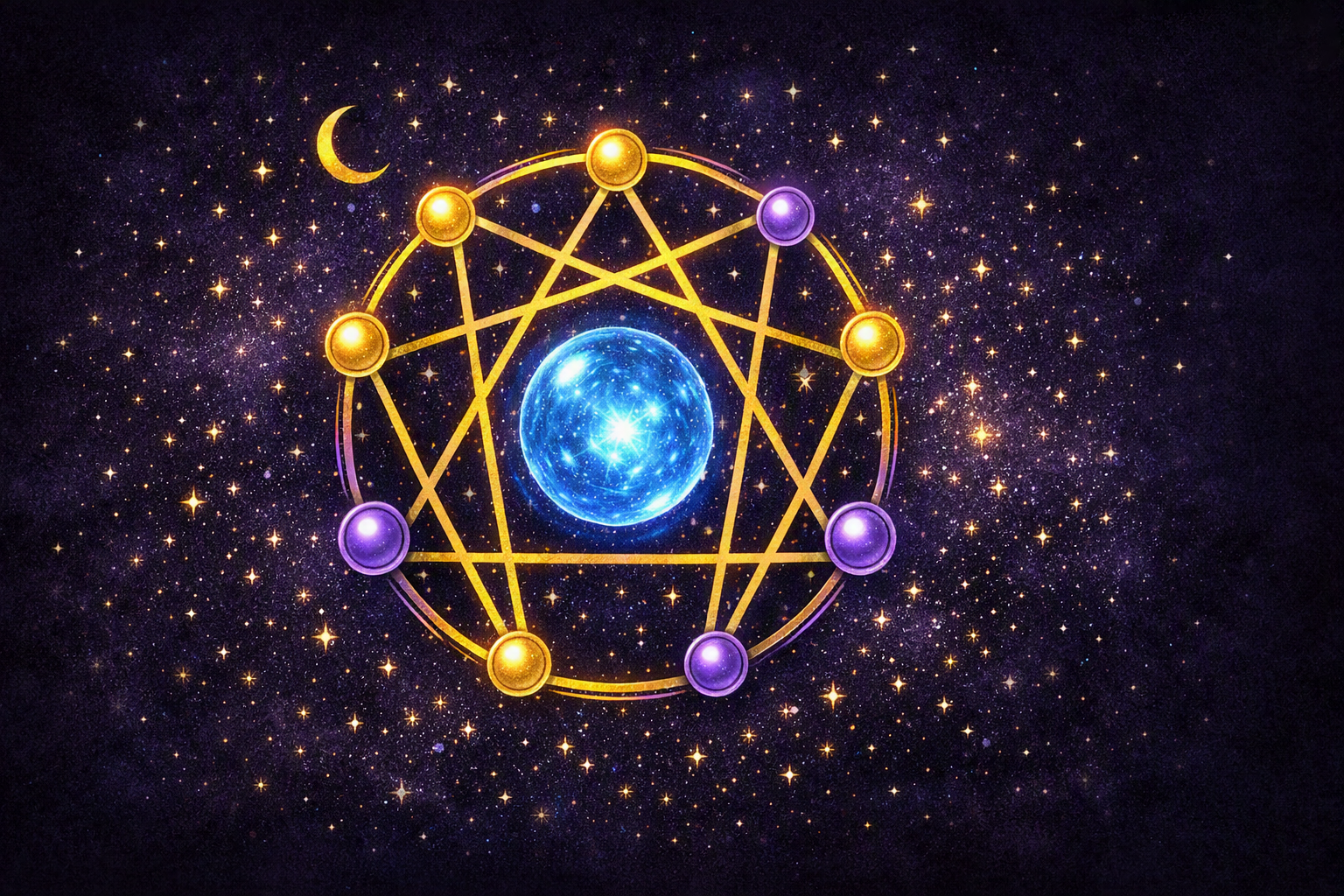
The Enneagram test is a personality assessment that reveals your core fear and core desire across 9 distinct types, explaining why you react the way you do beneath surface behavior. Unlike the MBTI, which maps how you perceive and decide, the Enneagram descends to personality's foundation — your deepest fears, desires, and defense mechanisms. This complete guide unpacks the three intelligence centers, all 9 types, wings, growth arrows, and how the Enneagram interweaves with Tarot archetypes and astrological energy.
What Is the Enneagram: The Three Intelligence Centers
The word "Enneagram" comes from the Greek ennea (nine) and grammos (figure) — an ancient symbol of nine points connected by lines. The 9 types fall into three centers, each answering a fundamental question about life.
The Head Center (Thinking): Fear and Safety
Types 5, 6, and 7 experience the world through the mind. Their core emotion is fear — of scarcity, of danger, of being overwhelmed. The Head Center's task is learning to trust: that the world is fundamentally supportive enough.
The Heart Center (Feeling): Shame and Identity
Types 2, 3, and 4 experience the world through the heart. Their core emotion is shame — the quiet sting of "I am not enough." Heart types seek validation outward through love and achievement, or retreat inward into fantasies of uniqueness. Their task is discovering that their worth never needed proving.
The Body Center (Instinct): Anger and Boundaries
Types 8, 9, and 1 experience the world through instinct and the body. Their core emotion is anger — at being controlled, overlooked, or facing a world that isn't as it should be. Their task is letting raw vitality coexist with stillness.
The 9 Personality Types, One by One
Head Center: The Thinkers
- Type 1 · The Reformer — Principled, disciplined, driven by integrity. Core fear: being bad, corrupt, defective. Core desire: to be good, right, and perfect.
- Type 2 · The Helper — Warm, generous, needs to be needed. Core fear: being unloved. Core desire: to feel loved.
- Type 3 · The Achiever — Efficient, adaptable, goal-oriented. Core fear: being worthless. Core desire: to feel valuable.
Heart Center: The Feelers
- Type 4 · The Individualist — Deep, authentic, emotionally rich. Core fear: having no identity, being insignificant. Core desire: to find themselves and be true to it.
- Type 5 · The Investigator — Curious, insightful, intensely focused. Core fear: being helpless, depleted. Core desire: to be capable and understanding.
- Type 6 · The Loyalist — Reliable, vigilant, collaborative. Core fear: losing support and guidance. Core desire: security and support.
Body Center: The Doers
- Type 7 · The Enthusiast — Spontaneous, optimistic, high-energy. Core fear: being deprived, trapped in pain. Core desire: to be satisfied and fulfilled.
- Type 8 · The Challenger — Confident, decisive, protective. Core fear: being controlled or harmed. Core desire: to be in control of their own life.
- Type 9 · The Peacemaker — Accepting, calm, empathetic. Core fear: loss of connection, conflict. Core desire: inner peace and stability.
By now you're probably torn between two or three types — that's normal. Your true type is often the one you most resist claiming: the Enneagram describes your defenses, and no one enjoys seeing their armor catalogued.

Wings and Arrows: The Moving Shape of You
Your type isn't an island. The lines on the Enneagram symbol reveal the dynamics living inside every person.
Wings: Your Second Shade
The numbers on either side of your type are your possible wings. A 9 might carry an 8-wing (more assertive) or a 1-wing (more idealistic). Wings tint your core motivation the way planetary placements color a chart — same core drive, different flavor.
Integration and Disintegration: Shape-Shifting Under Stress
The connecting lines map your movement: the disintegration arrow (stress) shows the low side of another type — a 5 under stress scatters into 7-like distraction. The integration arrow (growth) grants access to another type's high side — the secure 5 moves toward 8's confident action.
This dynamic machinery makes the Enneagram not a label but a growth roadmap: it tells you where stress will push you, and where your strength is hiding. That same "path through difficulty" is exactly what a Celtic Cross reading maps with its positions for the challenge, the obstacle, and the outcome.
Enneagram × MBTI, Tarot, and Astrology: Assembling the Whole You
No single system exhausts a soul. The real insight happens at the intersections.
Enneagram × MBTI: Motivation Meets Cognition
MBTI describes how you perceive and decide; the Enneagram reveals why — which core desire all your striving ultimately serves. An INTJ who is an 8 wields strategy for control; an INTJ who is a 5 wields it for understanding. Only together are cognition and motivation complete — which is why a professional personality assessment reads both within a single soul profile.
Enneagram × Tarot: 9 Types, Familiar Archetypes
The Major Arcana resonate with the Enneagram with uncanny precision: the 8's raw force lives in the Strength card, the 1's moral law in Justice, the 7's chase of abundance in the Suit of Wands. Once you know your type, a Tarot reading speaks directly to your defenses — the cards no longer offer generic guidance, but show your core fear steering the ship while you're not looking.
Enneagram × Astrology: Motivation Meets Cosmic Color
Your birth chart maps the cosmic energy you were born with; the Enneagram reveals what you do with it. Two Leo Suns, one a 4 and one a 3, will burn that fire completely differently — the 4 into singular artistic expression, the 3 into stage-worthy achievement. The chart gives you fuel; the Enneagram gives you the engine.

How to Find Your True Type
Free short tests misjudge constantly — because tests measure behavior, and behavior can be performed. The reliable path combines three approaches:
- Read all 9 core fears aloud — notice which one makes your chest tighten.
- Trace your childhood patterns — your Enneagram formed long before your career and habits.
- Get a professional assessment — systematic evaluation plus deep reading of wings, arrows, and subtypes cuts through the fog of self-presentation.
Be patient with yourself. Finding your real type often arrives with a strange relief: the contradictions you could never name suddenly have one.
Conclusion
The Enneagram is not a verdict — it's a mirror made of deep water. It shows the fortress you built to escape your core fear, and the person you've been longing to become inside it.
Once you know what you truly fear and truly crave, the loops you keep falling into stop being fate and become curriculum. Combine this self-knowledge with the MBTI's cognitive map, Tarot's archetypal wisdom, and astrology's cosmic rhythm — what you get isn't a test result. It's an owner's manual for your soul.
Ready to meet the deepest version of yourself? Start your Enneagram deep assessment now and uncover the true engine of your soul.
See also: INFP idealization and pulling away