Minor Arcana Tarot Cards Explained: Cups, Pentacles, Swords, and Wands Meanings
Tommy Sherma
9/20/2026
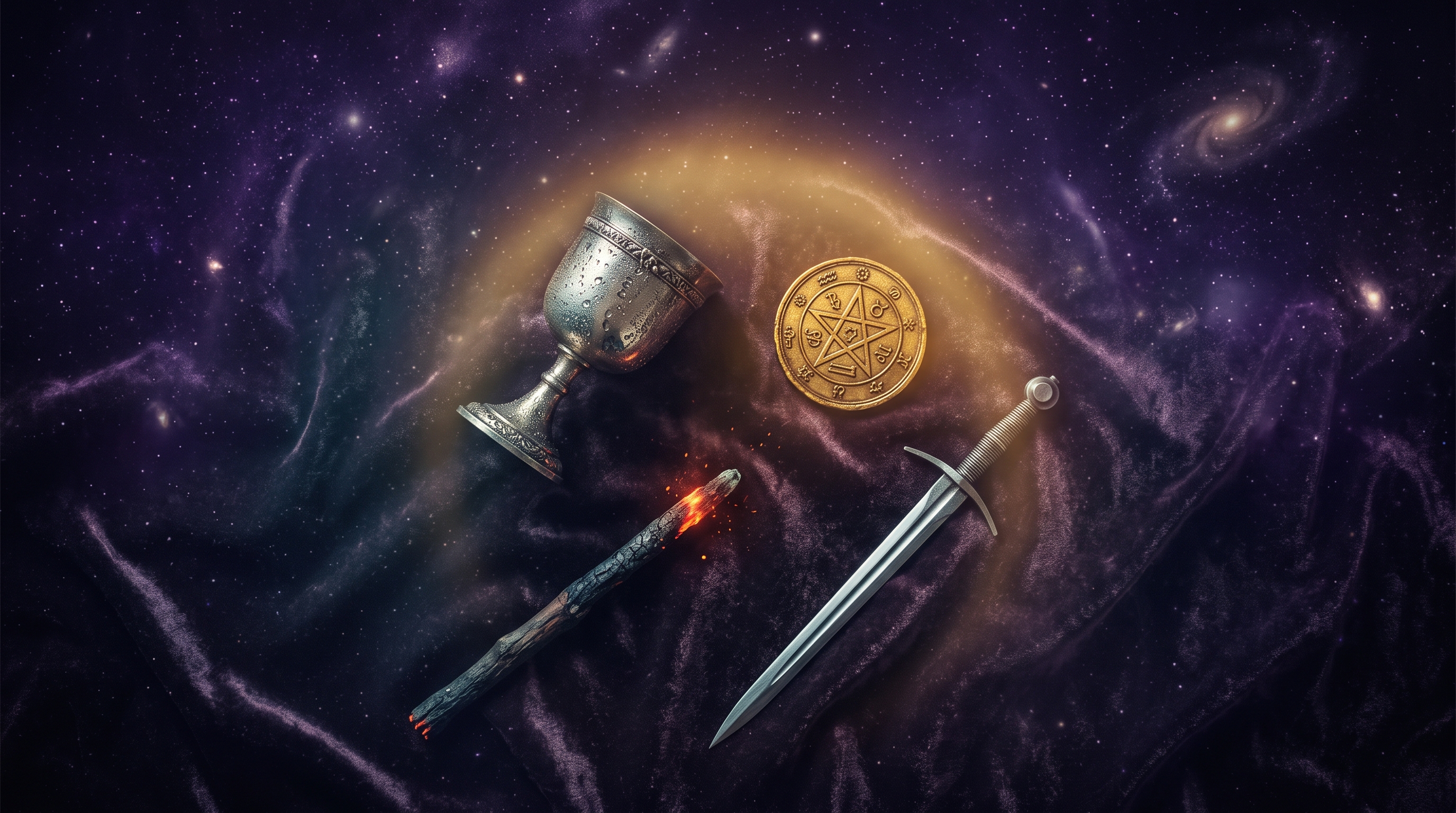
The 56 minor arcana cards are four complete languages—Cups, Pentacles, Swords, and Wands—each describing the same life from a different angle. Cups speak in feelings, Pentacles in receipts, Swords in sentences, and Wands in sparks. Learn a suit's language and you can read a card you have never seen before, which is the real skill beneath the complete guide to the 56 minor arcana cards.
Why the 56 minor arcana cards carry your daily life
The tarot deck splits into two halves. The Major Arcana tracks soul-level turning points. The four suits track Tuesday. A Major Arcana card is a chapter title; a minor arcana card is a sentence inside that chapter, specific and situational and usually describable to a friend in one line.
Each suit runs fourteen cards: Ace through Ten, then four court cards. Fourteen times four equals 56. That structure repeats in every suit, which means you never have to memorize 56 unrelated meanings. You memorize four elements and one story arc that replays in each of them.
| Suit | Element | Question it answers | Felt as | Shadow side |
|---|---|---|---|---|
| Cups | Water | What do I feel, and who do I love? | Tears, longing, dreams | Moodiness, avoidance |
| Pentacles | Earth | What can I build, hold, or afford? | Weight, texture, routine | Rigidity, scarcity thinking |
| Swords | Air | What do I think, and what is true? | Restless thought, sharp speech | Anxiety, coldness |
| Wands | Fire | What do I want, and what will I start? | Heat, urgency, appetite | Burnout, impatience |
Notice the question column. When a reading feels confusing, the fastest fix is to ask which question the card is answering rather than which keyword it carries.
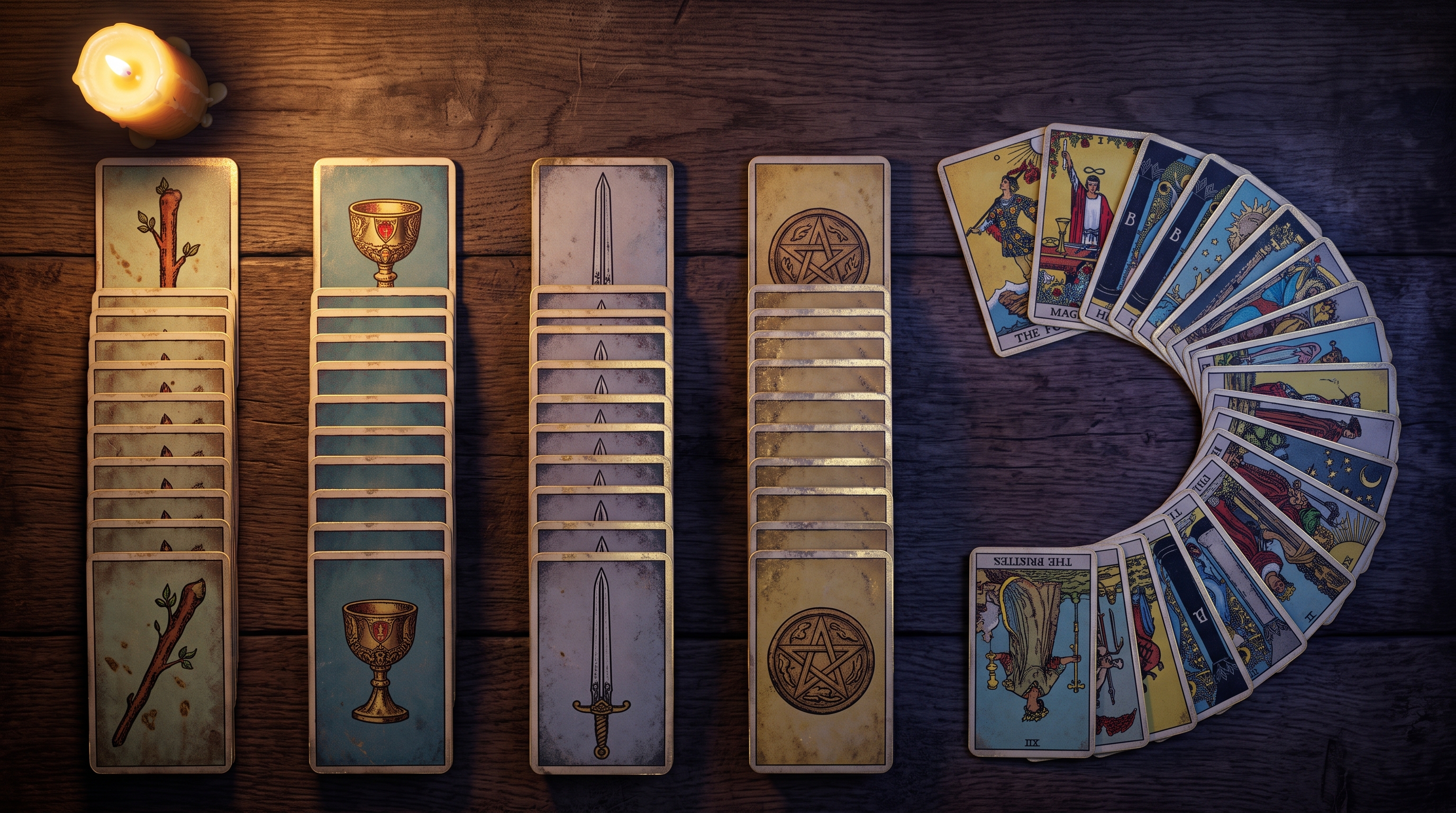
Cups tarot meanings: love tarot, grief, and the water you carry quietly
Cups is the suit of water: emotion, intimacy, memory, and imagination. In a love tarot reading it is the most literal suit in the deck, but it is not only romantic. A Cups card can describe a friendship, a creative current, a dream you cannot shake, or a feeling you have been carrying without naming it.
The arc runs from raw to full. The Ace is a feeling arriving: a first tear, a first crush, an offer of closeness. The Two is exchange, the giving and receiving that makes a relationship mutual. The Three is social joy, the table with room for more chairs. By the Six it becomes nostalgia, giving or receiving something because of the past. The Ten is emotional completion, a household or chosen family where water is contained instead of spilling.
Then there is the middle, which beginners skip. The Five of Cups stands over three spilled cups and ignores the two still standing, which is grief that is real but incomplete. The Eight of Cups walks away from everything that looked full. The Nine of Cups sits alone with a satisfied smile that can read either as contentment or as a wish that never became a life.
Reading Cups in a love spread
- Ace, Two, Ten: beginnings, mutual exchange, long-term emotional security.
- Three and Six: friendship and history; the past is present in the reading.
- Five and Eight: loss and leaving, often appearing when the querent already knows.
- Seven and Nine: wishful thinking; the cards ask what is imagined versus what is lived.
Reversed Cups
A reversed Cup rarely means "no love." More often it means feeling that has been suppressed, overexpressed, or aimed at the wrong person. The Five reversed can mean starting to see the two unspilled cups. The Eight reversed can mean staying when you meant to go.
Pentacles tarot meanings: money, the body, and results that take time
Pentacles is earth: the body you live in, the money you earn, the home you keep, the work you repeat. If Cups asks what you feel, Pentacles asks what is actually here. This suit is unglamorous in the best way. It is why a career question so often lands on a card with a coin on it instead of a card with a crown.
The Ace opens a material opportunity: an offer, a deposit, a first honest budget. The Three shows craft being seen by others. The Eight is repetition, the workbench, the same motion improved, and it may be the most underrated card in the deck for anyone building a skill. The Nine is earned comfort. The Ten is inheritance and long-term stability, the kind of wealth that outlives you.
The difficult Pentacles describe scarcity and its psychology. The Five shows people walking past a lit window in the cold, which is exclusion, poverty, or the feeling of it. The Seven is the pause where you ask whether the effort is paying. The Four grips what it has, and generosity stops at the door.
The timing lesson in this suit
Pentacles is the slowest suit and the most honest about it. When a spread is heavy with Pentacles, especially the Eight, Nine, or Ten, the message is usually patience plus repetition: the result is available, but not yet and not without the boring part. When the Four or Five dominates instead, the message is often about the fear of scarcity rather than scarcity itself. This is also why the suit pairs so well with a question-first approach to how to read tarot cards; Pentacles rewards specific questions about money, health, and time rather than open-ended ones.
Swords tarot meanings: naming the thought behind the anxiety
Swords is air, and air is mental: thoughts, words, decisions, contracts, truth-telling, and the arguments that happen inside your own head at midnight. This is the most misread suit. People see blades in the artwork and assume violence. Usually it is cognition.
The Ace is a clear idea, a truth spoken once and cutting cleanly. The Two is a stalemate, a blindfolded figure balancing two blades, which is a decision avoided rather than made. The Three is heartbreak expressed in words, the thought that finally hurts enough to say out loud. The Six is passage, moving across water toward a calmer shore, often literal travel or leaving a mental state. The Ten is the end of a thought cycle, the point where the story collapses because it has been carried too far.
The Nine of Swords, Dana's card, is the mind turned against its owner: insomnia, dread, the loop. The Ten is the same energy at the end of its rope. Neither card promises the disaster it depicts. Swords describe perception, and perception can be revised, which is the difference between a frightening reading and a useful one.
How Swords behaves across a tarot reading
- Court cards in Swords describe communicators: the messenger, the debater, the honest advisor, the judge.
- In a health question, Swords usually point to stress and sleep; Pentacles handles the body itself.
- Swords beside Wands predicts fast, blunt action; beside Cups it predicts hard conversations with people you love.
Wands tarot meanings: desire, momentum, and the burnout nobody warns you about
Wands is fire: appetite, ambition, creativity, and the urge to start something before you feel ready. Where Swords thinks, Wands moves. Where Pentacles finishes, Wands ignites.
The Ace is the spark, an idea arriving with heat. The Two is the planning moment, one world in each hand, deciding whether to expand. The Three is the first visible result, the project posted, the momentum seen from outside. The Six is a public win that arrives before the work is finished. The Eight is speed, messages flying, progress that feels effortless. The Ten is the accumulated load, everything you agreed to carry now stacked in your arms.
That contrast between the Eight and the Ten is the suit's real lesson. The same fire that makes you fast in the Eight makes you heavy in the Ten. Burnout in Wands is not laziness; it is a full schedule with no empty hands. For context, the Major Arcana holds the turning points of a life while the suits hold the traffic between them, which you can trace through the 22 Major Arcana cards.
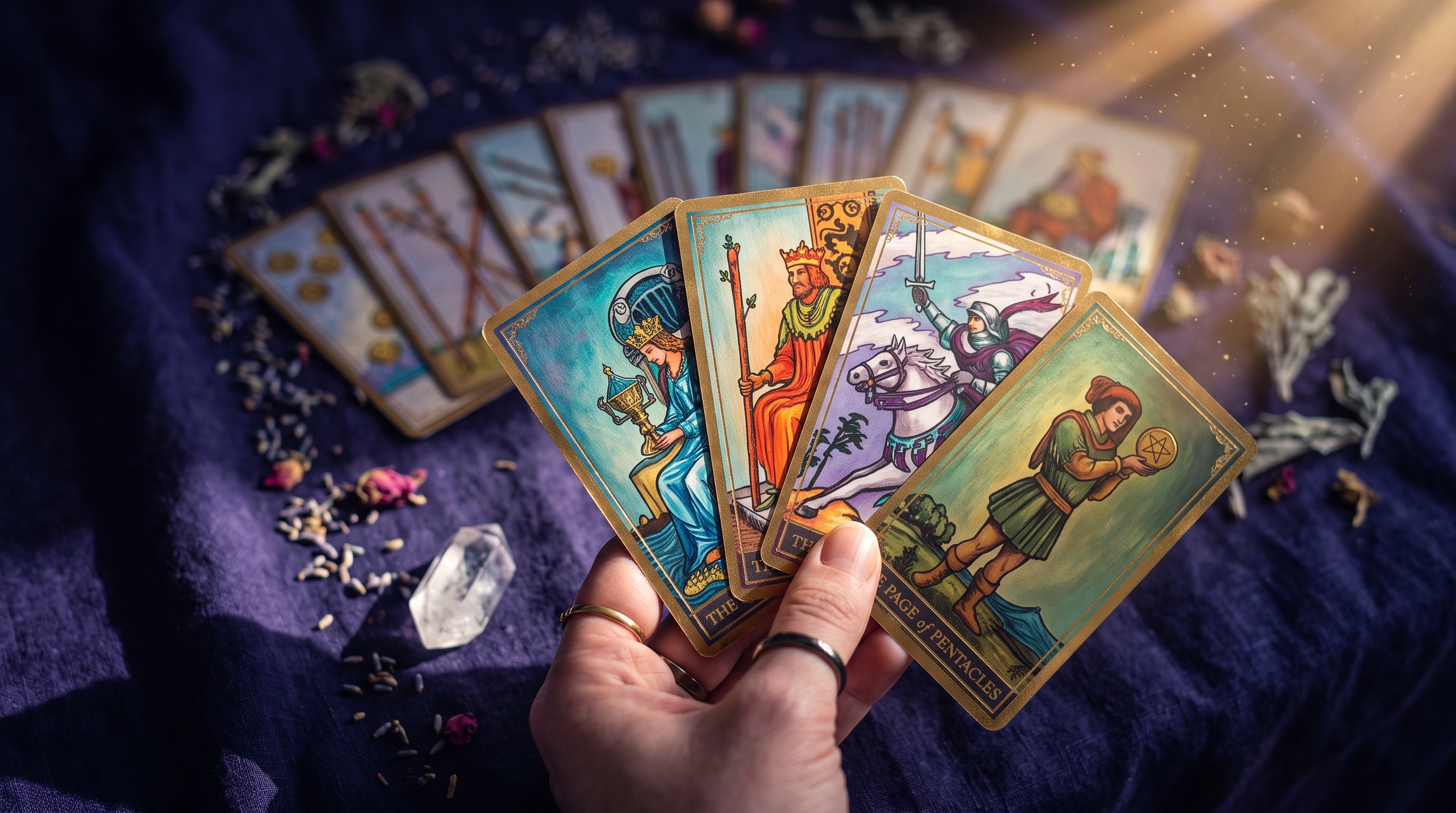
Reading Wands in career and creativity questions
- Ace, Three, Six: initiation, visibility, momentum; start now, refine later.
- Two and Seven: choice and defense; you are holding ground while deciding.
- Four and Ten: stability that has become a burden; ask what can be handed back.
- Knight, Queen, King: leadership styles, whether impulsive, magnetic, or commanding.
How to read minor arcana tarot cards: numbers, court cards, and the grammar of a spread
Suits tell you the territory. Numbers tell you the stage of the story inside it.
Ace through Ten as one repeating arc
- Ace: the raw element, unshaped and undiluted.
- Two: polarity, choice, the relationship between two things.
- Three: first visible result, or a third party entering.
- Four: structure and stability, sometimes stagnation.
- Five: disruption; the element is challenged.
- Six: adjustment; harmony restored or a debt acknowledged.
- Seven: assessment, strategy, questioning the position.
- Eight: mastery through repetition, or sheer speed.
- Nine: near-completion; the element at its fullest.
- Ten: completion, and the weight that comes with it.
The Nine of Cups and the Nine of Swords share a number and share nothing else. One is emotional fullness, the other mental overload. The number is the stage; the suit is the subject.
The four court cards as maturity levels
- Page: the student, beginner energy, messages, curiosity without skill.
- Knight: the mover, action and pursuit, often impulsive.
- Queen: inner mastery, the element held with care and empathy.
- King: outer mastery, the element directed, managed, and ruled.
A question that comes up constantly during a tarot reading is whether a court card is a person or a mood. It can be either. Read it as a person when the question involves someone specific; read it as an approach when the question is about your own behavior. In the Celtic Cross spread, where one position addresses the querent and another the environment, that distinction decides how the whole reading lands.
How the four suits combine in a tarot reading
Single cards are vocabulary. Pairs are sentences. Learning a handful of suit combinations speeds up recognition far more than adding more keywords.
| Combination | Typical message |
|---|---|
| Cups + Swords | A feeling that needs to be said out loud; hard conversations |
| Pentacles + Wands | Building under pressure; funding a fast idea |
| Cups + Pentacles | Emotional security; home and comfort treated as a value |
| Swords + Wands | Quick decisions, blunt talk, arguments with momentum |
| Three different suits | Life is moving on several fronts; no single fix |
| All four suits | Wholeness, or overwhelm; check the scope of the question |
Absence matters too. When a spread contains no Pentacles, the question is usually not actually about money, even if the querent framed it that way. When no Cups appear, the emotional layer is being avoided. Missing suits are information rather than gaps.

Common mistakes when learning minor arcana tarot card meanings
- Memorizing keywords instead of questions. "Sword equals conflict" breaks immediately on the Two of Swords, which is about avoiding conflict. Learn the question each suit asks.
- Reading reversals as opposites. A reversed card shows the same energy blocked, internalized, or overdone, not the opposite card.
- Ignoring the element. A Pentacle and a Wand in the same position do not mean the same thing with a different picture.
- Assuming court cards are always people. Half the time they describe how you are handling the situation.
- Reading each card alone. Suits repeat for a reason, and the repeated element is the headline of the spread.
- Skipping the question. A card has no fixed meaning outside the question it is answering.
Daily tarot practice: a drill that builds real recognition
Recognition, not memorization, is what makes the suits feel obvious. A short daily tarot drill gets you there faster than any glossary.
- Draw one card. Before checking anything, name the suit and the question it answers.
- Name the number and where it sits on the arc.
- Write one sentence connecting the card to something specific that happened in the last 24 hours. Specific beats poetic.
- Only then check a reference and note exactly where you were wrong.
Work one suit per week rather than mixing suits daily. A week of Cups makes Cups obvious; a week of Swords makes mental chatter visible. Once the four languages separate in your head, spreads stop being puzzles and start reading like paragraphs, especially inside structured layouts like the ten essential tarot spreads where every card has a defined role.
If you want a second opinion on a spread you have already pulled, a Tarot Reading can confirm whether the suit you drew matches the situation you actually described.
Try It Yourself
Shuffle a virtual deck and draw 1, 3 or 5 cards with instant meanings.
Try It Free →