Synastry Astrology: How to Read Relationship Compatibility in Two Birth Charts
Tommy Sherma
9/19/2026
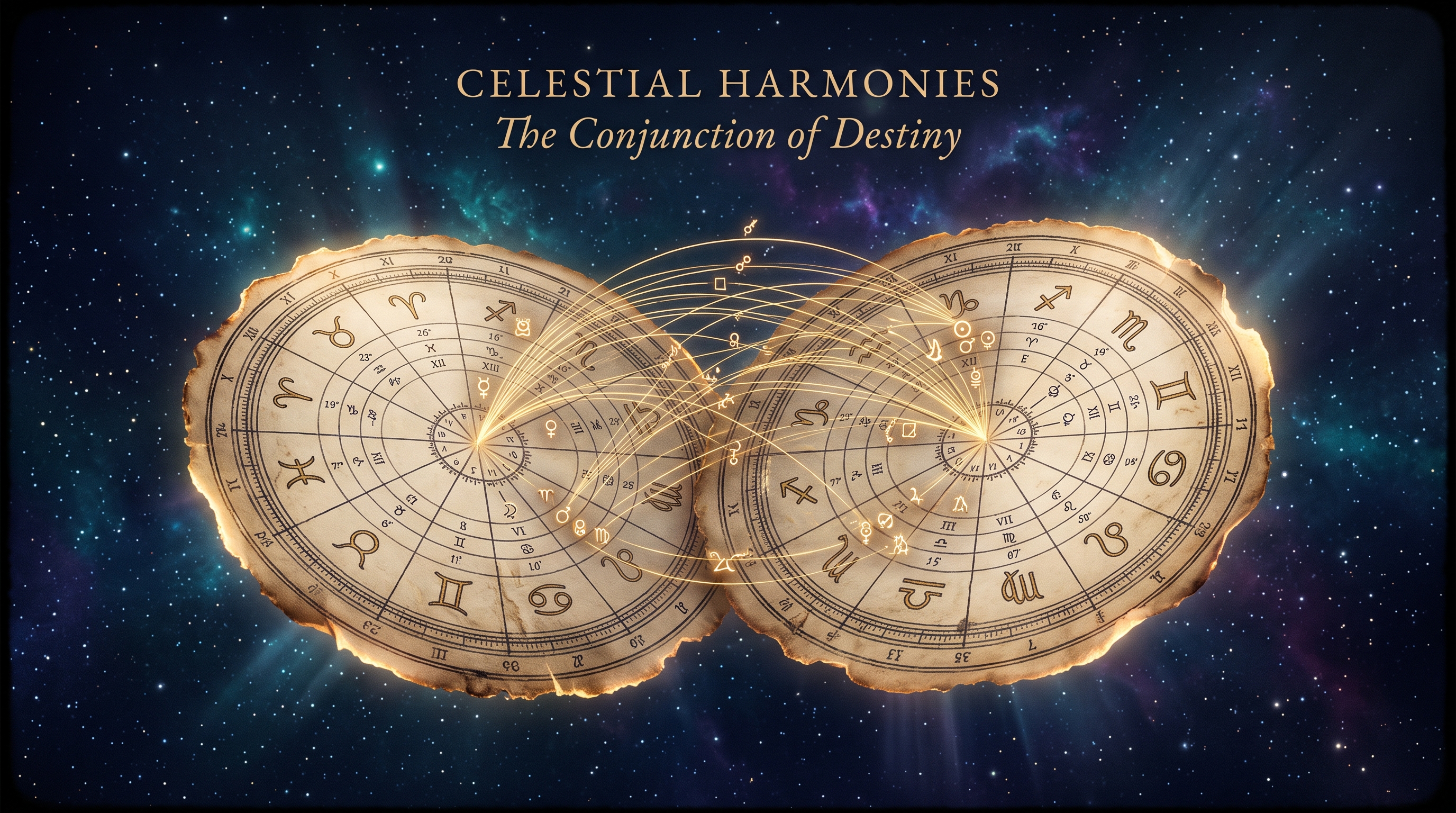
Synastry astrology is the practice of reading relationship compatibility by overlaying two birth charts and studying the contacts between them — whose Venus lands on whose Saturn, whose Moon falls into whose 7th house. It matters because the same placement can behave completely differently in isolation than it does when it touches someone else's chart. This guide follows the order that actually works: signs first, aspects second, house overlays third, while flagging the traps that make beginners see doom in every square.
Why Synastry Astrology Reads Two Birth Charts, Not One
One Chart Is Wiring, Two Charts Are Weather
A single natal chart tells you how one person is built. Two charts tell you what happens between them. Most relationship friction is not a personality defect; it is two valid operating systems running at different speeds. A Capricorn Moon is not cold — it is slow to trust and shows love through logistics: remembering the appointment, fixing the leak, showing up on time. Pair that with a Leo Moon that needs loud, immediate reassurance and you get a couple where one partner feels unappreciated and the other feels smothered. Neither is doing anything wrong.
The practical rule that follows: never read a synastry contact in isolation. A Venus–Saturn square reads as “withholding and obligation” in one pairing and “steady, loyal, willing to commit slowly” in another. What changes the verdict is the rest of the grid — the condition of both Moons, the 7th house, and how many supportive contacts are holding the hard ones in place.
Synastry vs. Natal vs. Composite
| Chart | Built from | Question it answers | Where it fails |
|---|---|---|---|
| Natal | One person's birth data | Who am I on my own? | Says nothing about chemistry |
| Synastry | Two natal charts overlaid | How do we affect each other? | Hundreds of contacts, easy to overread |
| Composite | Midpoint of both charts | What is the relationship itself? | No sense of who feels what |
| Davison | Averaged birth moment | The relationship as a single entity | Abstract and hard to verify day to day |
Synastry is the layer that explains experience. If you cannot yet read a single chart on its own, fix that first — synastry is the same vocabulary applied twice. Work through this guide to how to read a birth chart, then come back and overlay.
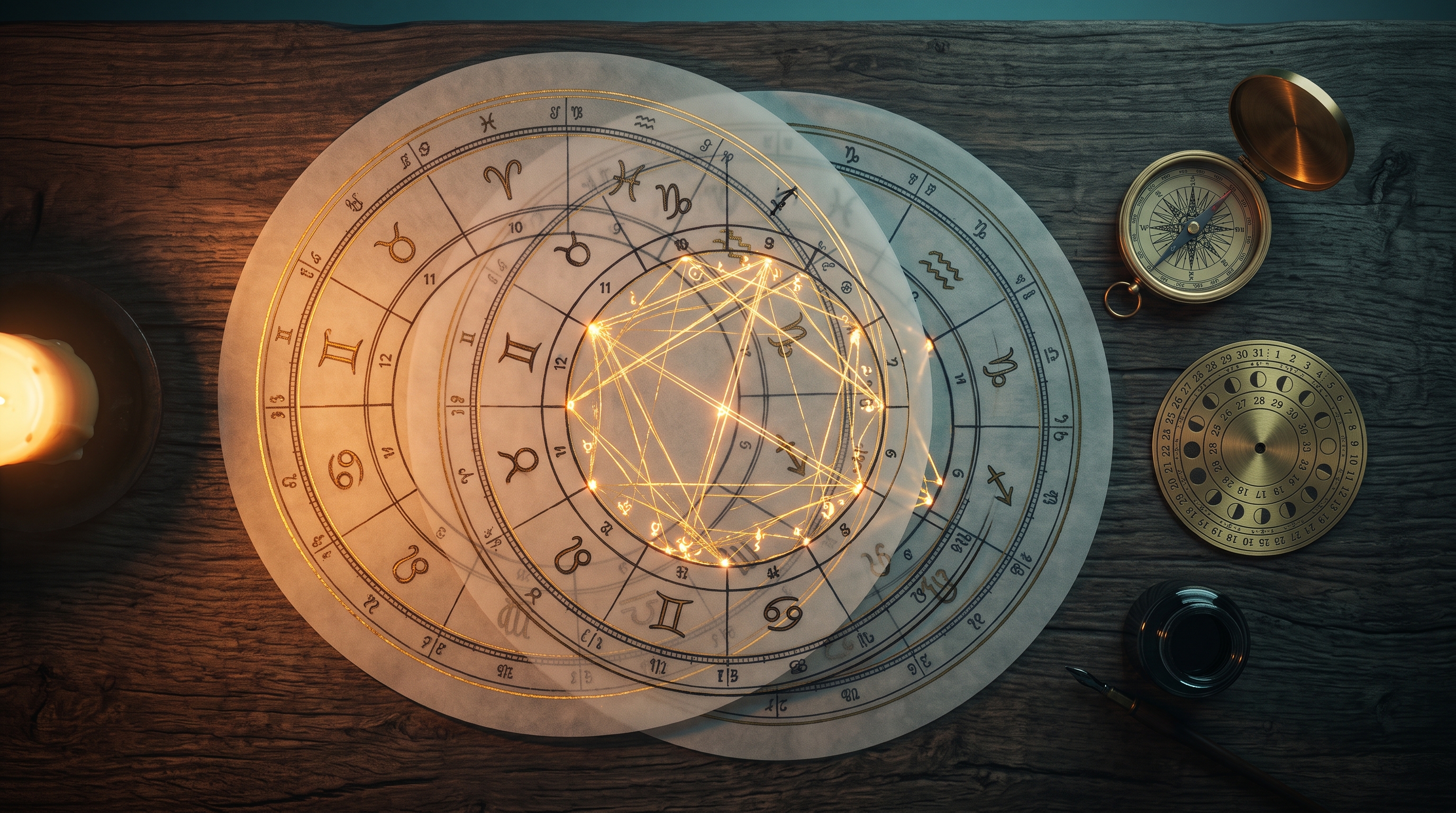
Start With Sun, Moon, and Rising Sign Before Any Aspect
Sun to Sun Sets the Pace, Not the Chemistry
Sun contacts govern tempo: how quickly each person processes, decides, and recovers from conflict. Sun trine Sun usually means two people who cool down at similar speeds. Sun square Sun means one wants to resolve it now while the other needs to walk it off, and each reads the other's timing as disrespect. Elements matter more than signs here — fire and air Suns think out loud; earth and water Suns think internally. Two people can love each other deeply and still fight about when to talk.
Moon Contacts Decide Whether It Feels Like Home
This layer determines daily comfort. Moon conjunct Moon produces instinctive emotional shorthand — sometimes so comfortable that neither partner grows. Moon opposite Moon creates a see-saw: one comforts while the other vents, and the roles harden unless they consciously rotate. Moon square Moon is the “we love each other and still miss each other” placement, where each person's definition of care does not register as care to the other.
House placement sharpens all of it. A partner's Moon falling in your 4th, 8th, or 12th house gives them unusual emotional access — they get under your skin fast, for better and worse. Before judging any Moon contact, understand your own Moon sign meaning in plain emotional language rather than zodiac sign stereotypes.
Rising Sign: The Approach Layer
The Ascendant governs presentation, so contacts to it are about approach rather than depth. Someone whose Sun or Venus touches your rising sign tends to like how you come across before they know you at all. Matching Ascendant elements usually means similar social pacing: the same appetite for small talk, the same recovery time after a long party. Opposite Ascendants frequently produce the “we complete each other and also irritate each other” dynamic — accurate, but only half the story until you check both Moons.
Birth Chart Aspects in Synastry: Which Contacts Actually Matter
Hundreds of cross-contacts exist between any two charts. Most are noise. These five categories carry the weight:
| Cross-contact | How it feels | Most common misread |
|---|---|---|
| Sun–Moon (any aspect) | Familiar, complementary, “you get me” | Assumed to guarantee longevity |
| Moon–Saturn | Protective, weighted, sometimes parental | Read as cruelty instead of fear |
| Venus–Mars | Sexual and aesthetic pull, playful pursuit | Mistaken for emotional compatibility |
| Mercury–Mercury | Conversation rhythm, humour, argument style | Underrated until communication breaks |
| Moon–Pluto | Intense bonding, jealousy, transformation | Mistaken for fate rather than intensity |
Direction Changes Everything
Treat every contact as an arrow, not a line. When your Venus conjuncts their Saturn, you feel warmth and they feel responsibility. Flip the direction and the experience flips with it. Moon–Saturn works the same way: the Moon person feels held or restricted, the Saturn person feels needed or burdened, and neither description fits once the roles reverse.
Orbs: Tighter Beats More
Within 3 degrees, a contact is loud and obvious in daily life. Between 3 and 6 degrees, it shows up mainly under stress. Past 8 degrees, it is background unless several contacts cluster in the same area of the chart — three loose contacts to the same house behave like one tight one. Before applying orbs, make sure the mechanics make sense in a single chart; they are explained in this breakdown of planetary aspects in your natal chart.
House Overlays: The Layer Most Readers Skip
The Overlays You Notice First
Overlays explain why two couples with identical aspects can have completely different relationships. Sun, Moon, or Venus landing in a partner's 1st, 5th, 7th, or 8th house is felt immediately: attraction, play, partnership, or intensity. Jupiter in someone's 2nd or 10th house often feels like generosity and career support. Saturn in the 7th is the classic long-haul signature — commitment and weight arriving together, rarely one without the other.
Stacked Houses Show Where the Relationship Lives
Count the planets rather than admiring a single one. If four of your planets fall in a partner's 5th house, the relationship tends to live in romance and recreation and struggles to move into chore-sharing and logistics. If four land in the 12th, the bond may feel private, dreamlike, and difficult to explain to friends. Density tells you where a couple keeps returning. A clear map of the 12 houses and what they govern is worth more here than any love compatibility score.
Synastry Reading Checklist: Green Lights, Grey Zones, Red Flags
| Signal | Green light | Grey zone | Red flag |
|---|---|---|---|
| Moon contacts | At least one supportive Moon tie | Only hard Moon ties | No Moon contact plus heavy Saturn |
| Communication | Mercury in compatible elements | Mercury square Mercury | Mercury–Saturn with nothing softening it |
| Attraction | Venus–Mars backed by a Moon tie | Venus–Mars alone | Venus–Mars plus Mars–Pluto friction |
| Commitment | Saturn trine or sextile personal planets | Saturn square Sun or Moon | Saturn opposite Venus with no Jupiter relief |
Hard Aspects Are Not Dealbreakers
A square or opposition between two charts is energy under pressure, and pressure builds muscle. Couples with only trines and sextiles often plateau — comfortable, unbothered, and slightly bored. The question is never “is there a hard aspect” but “what is holding it.” One supportive Moon or Jupiter contact can turn a difficult Saturn tie into a durable commitment instead of a slow punishment.
The Grey Zone Test
When a chart looks half-and-half, stop reading and start asking. Do you both recover from conflict within a comparable window? Can you name what the other person needs without guessing? Do you like each other outside of attraction? Synastry describes conditions, not outcomes. The chart shows the terrain; the couple decides whether to walk it.
Daily Horoscope Columns and Sun Sign Compatibility: Where They Mislead
Why Sun Sign Compatibility Is a Rough Proxy
Sun sign columns compare one placement out of dozens. They ignore houses, which is where most relationship experience actually lives, and they flatten the Moon — the single most important body in compatibility work. A “perfect match” pairing can still have two Moons in incompatible elements and no Moon contact at all. Read sun sign compatibility as a first-impression guess, never a verdict.
What Horoscopes Are Good For
Transits. Following where the slower planets currently sit tells you when a couple is likely to feel pressure, make a decision, or suddenly want to talk about the future. Use that as timing context for a synastry reading rather than as a compatibility report — a forecast describes the moment, not the match.

Adding MBTI Personality Types and Tarot as Second Opinions
Where Typology and Astrology Agree
Astrology and personality systems look at different layers of the same person. Astrology maps appetite, instinct, and emotional timing; typology maps how someone thinks and recharges. When a synastry reading suggests a “needs space” dynamic, a look at the 16 MBTI personality types often confirms which partner needs the space and in what form — solitude, structure, or simply less input. Agreement between the two systems is useful; disagreement is more useful still, because it tells you which layer of the relationship is struggling.
Using Tarot Reading for Timing, Not Verdicts
Tarot is a poor judge of compatibility and a decent tool for timing. A love tarot spread that asks “what should we address before the next step” produces something astrology cannot: a specific, present-tense conversation prompt. Use tarot cards to surface what both people already sense, and keep the long-range structural questions — commitment capacity, emotional needs, conflict style — in the charts.
How to Read Your Own Synastry Without Overreading It
A Six-Step Order of Operations
- Compare Suns and elements for pace and processing style.
- Compare Moons for daily comfort and emotional vocabulary.
- Compare Ascendants for first-impression and social rhythm.
- Check the six heavyweight contacts: Sun–Moon, Moon–Saturn, Venus–Mars, Mercury–Mercury, Moon–Pluto, Sun–Saturn.
- Count house overlays and read the two densest houses as the relationship's home base.
- Only then weigh the hard aspects, and ask what softens each one.
What Synastry Cannot Tell You
It cannot tell you whether someone is honest, whether they carry their share of the work, or whether you will still enjoy their company years from now. It cannot tell you to stay or leave. What it can do is explain why the same argument keeps happening and name the need sitting underneath it — which is usually enough to change the conversation.
If you want a starting point that is not a compatibility score, pull up both charts side by side and read one layer at a time. Try natal-chart to map your own placements first, so you know exactly which of the contacts you are reading belong to you.