Ten of Wands in a Career Reading: Burnout, Carrying Everything Alone, and When to Put It Down
Tommy Sherma
10/10/2026
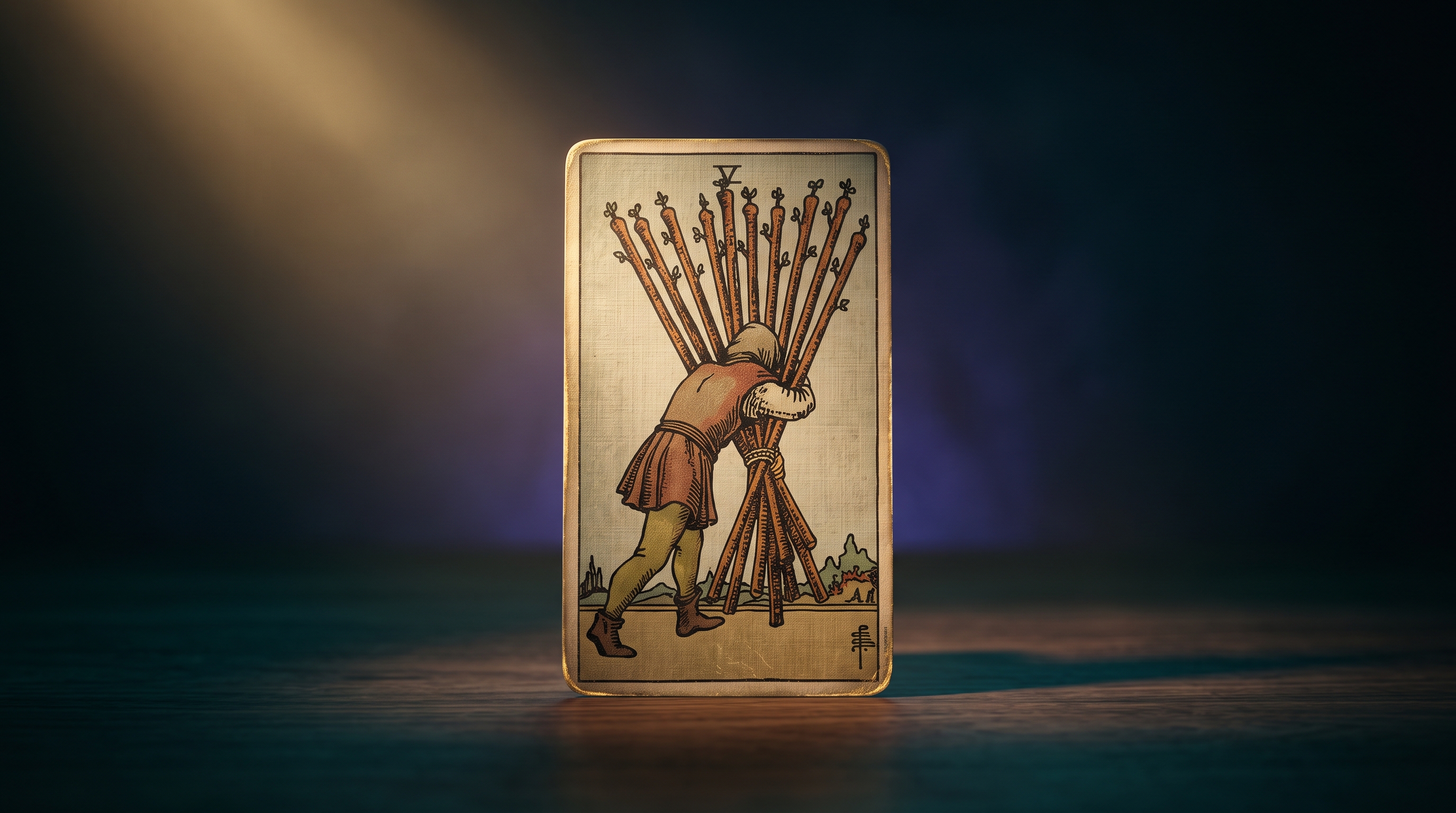
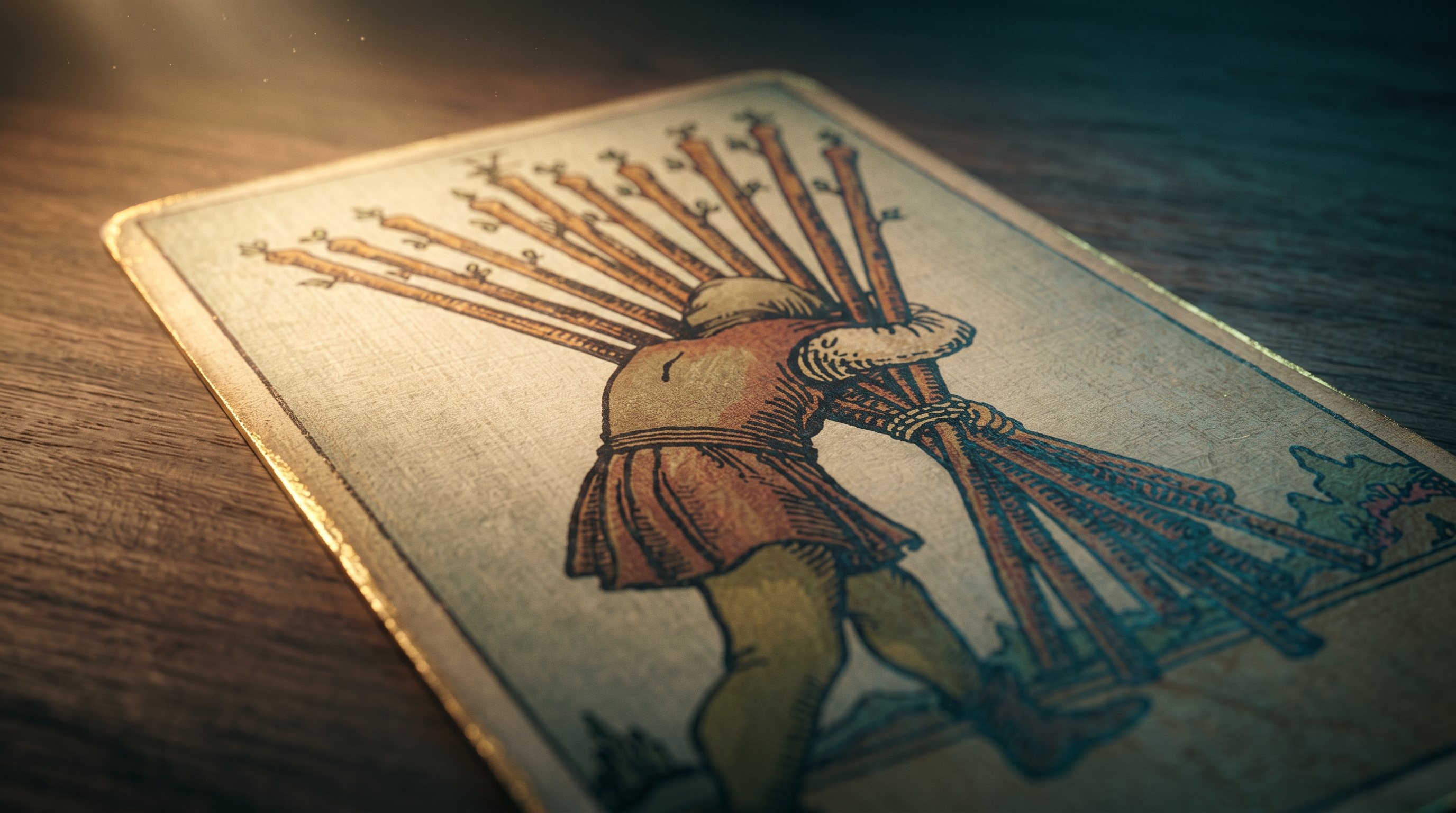
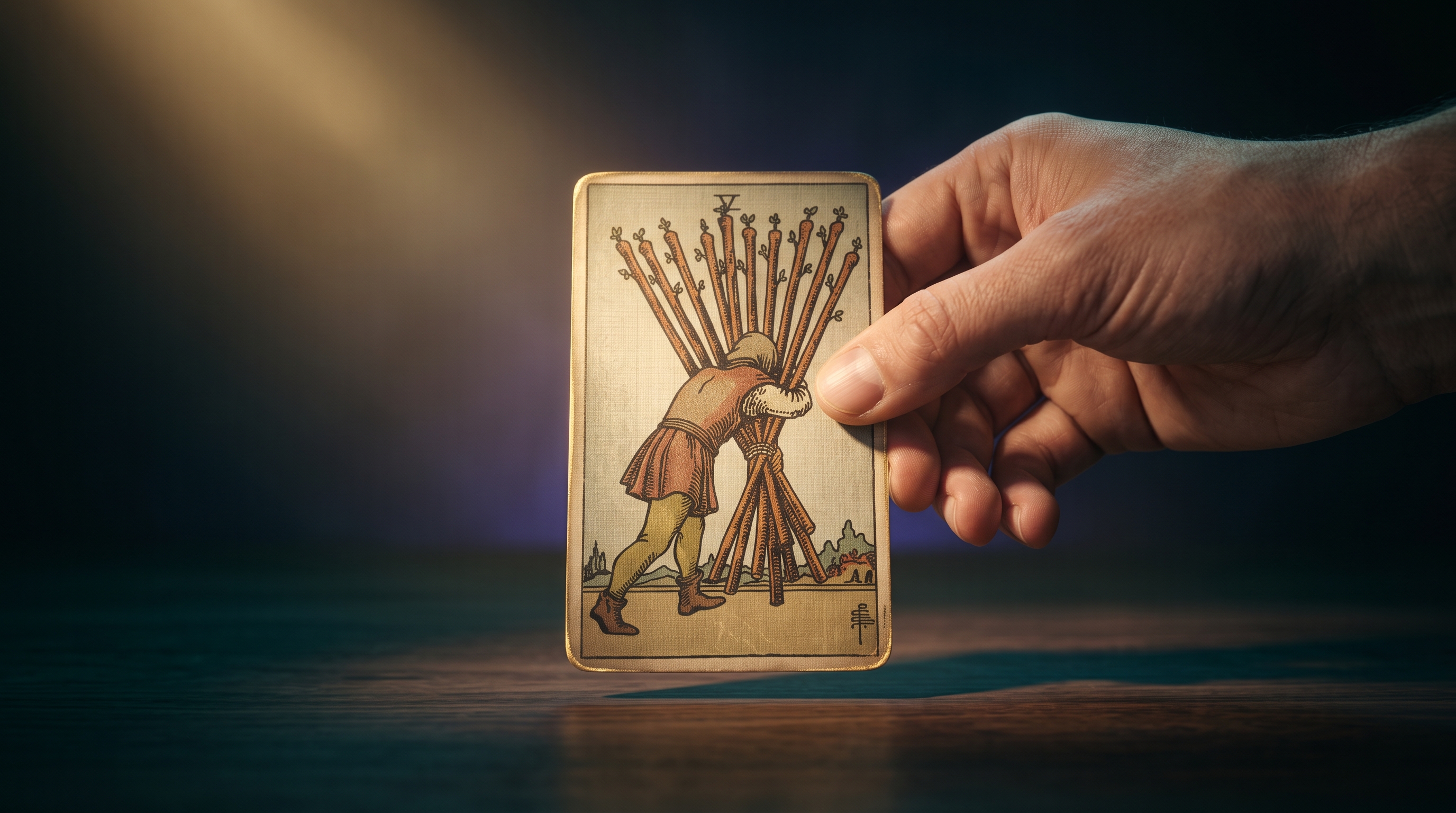
The Ten of Wands in a career reading means your workload is genuinely too heavy, you are the only one holding it, and the card's instruction is to set part of it down rather than carry it more efficiently. Ten staves bundled into a single armload, a town already in sight, a face completely hidden behind the load — this is the minor arcana's most literal picture of overload. Read at work, it says the problem was never your effort. It is that nobody else is holding anything.
Most readings stop at a sympathetic "you're overworked." The sharper reading is structural, and it is the angle this article keeps returning to: the Ten of Wands rarely describes work that was handed to you. It describes work you absorbed — the process only you understand, the task nobody else volunteered for, the message you answered at night because leaving it felt worse. That makes it a handoff problem, not a stamina problem, and handoffs can be fixed in ways that willpower cannot.
Ten of Wands in a Career Reading: Burnout, Carrying Everything Alone, and When to Put It Down
What the image is telling you
Every detail in the card is deliberate. The figure stands upright, so the strength is real. The road is straight and the town is close, so the goal is genuinely within reach. The staves are bound together, so the load travels as one mass instead of as ten separate decisions. And there is no second person anywhere in the frame.
That missing companion is the reading. Not the ten staves — the solitude.
- The face is hidden. You cannot see the road because the bundle blocks the view, which is why planning ahead feels impossible right now.
- The town is near. Relief is close enough that walking away looks premature, so you keep going instead.
- The bundle is carried, not dragged. This is competence under strain, not collapse.
- Nothing is falling. The system is working — because you are the system.
Upright in a work context
Upright, the card appears in recognisable patterns: you are the only person who knows how a recurring process runs, you absorbed a departed colleague's tasks "temporarily," you are the default fixer in several threads at once, and you agree in the meeting and regret it at night. The workload is not imaginary. Neither is the resentment that arrives with it.
What it does not mean
It is not a verdict that you chose the wrong job, and it is not a command to resign. It is also not proof that you are bad at boundaries — that framing hands the entire problem back to the person already carrying everything. Telling someone in this position to relax is the equivalent of telling them to hold ten staves more comfortably.
Upright, reversed, and the stuck reversal
| Position | What it looks like at work | The catch |
|---|---|---|
| Upright | Overloaded, still delivering, quietly furious | The load is being managed, not reduced |
| Reversed | You finally drop something — a task, a client, a standard | Relief arrives before the handoff does |
| Reversed, heavy | You refuse help out of pride, then collapse | Dropping the load and dropping the rope are different acts |
A reversed Ten of Wands usually means the release has already begun. The work ahead is to put the bundle down somewhere a colleague can reach it, rather than letting it fall where it stands.
Burnout Signals in the Ten of Wands Tarot Card Meaning
Within this tarot card meaning there are three signals worth more than the generic "you're tired," and each one calls for a different response.
Competence that reads as availability
If you solve problems quickly, you receive more problems. Managers route work toward reliability rather than toward fairness, and after enough cycles that routing stops looking like a temporary arrangement.
Labour that never appears on anyone's list
Remembering the client's preference, warning people about the trap in the spreadsheet, onboarding whoever is new — none of it is assigned, all of it is load, and none of it shows up in a job description.
Resentment as data
Resentment in this card is not a character defect. It is an accurate signal that an exchange has become one-sided, and it usually arrives after the agreement rather than before it.
| Signal | What you say out loud | What the card hears |
|---|---|---|
| Competence | "It's easier if I just do it" | The work will never be redistributed |
| Invisible labour | "Someone has to remember" | Nobody agreed that someone is you |
| Resentment | "It's just a busy season" | The season has outlasted the season |
If you are still learning the deck, the minor arcana card guide is worth reading alongside this one, because the Wands suit runs a single arc from the Ace's first spark to this bundled exhaustion — and knowing the arc makes the ending legible instead of sudden.
Why You Keep Carrying Everything Alone: Minor Arcana Patterns at Work
A reader's situation
One reader, a clinic coordinator, watched the Ten of Wands land in her outcome position across several readings. Each time she said the same thing: she had no choice. Her department had lost a colleague and nobody had rewritten the roster, so the gap was covered by whoever noticed it first — and she always noticed first.
What she called "no choice" turned out to be a set of small, reversible decisions. She had never asked for the roster to be rewritten. She had never separated the tasks she was hired to do from the tasks she had inherited. She had never let a deadline slip in a way that made the imbalance visible to anyone but her. The card was not telling her to work less. It was telling her to make the load visible before it set like concrete.
The one thing you have never said out loud
In most of these readings there is a sentence the querent has rehearsed internally for months and never delivered: which two responsibilities are actually hers, and which ones arrived by silence. Saying it changes the card's position in the next spread far more reliably than restructuring your calendar.
The handoff problem, not a workload problem
Most work overload in the minor arcana is a distribution issue wearing a discipline costume. You can become more efficient and still be the only carrier; the bundle simply moves faster. The fix is transfer, not throughput.
There is an astrological version of the same pattern: professional pressure to be the reliable one sits at the centre of Mars in the tenth house. Where the Ten of Wands describes the armload, that placement often describes why you volunteered for it. Read more in the five of pentacles love reading.
Why the load feels like identity
Being needed is a form of security. Put the bundle down and you risk becoming optional, so the advice to "just delegate" never quite lands. This is why the card asks for a handoff rather than a mindset shift — a transfer is verifiable, and being able to see the transfer is what quiets the fear.
Reading the Ten of Wands in Tarot Spreads and Card Positions
Where the card falls matters more than the card itself, because the same exhaustion reads differently as a situation, an obstacle, or a forecast.
| Position | Question it answers | How the Ten of Wands answers it |
|---|---|---|
| Situation | What is actually happening? | You are the sole carrier of a shared load |
| Challenge | What is blocking you? | Your refusal to hand anything off |
| Advice | What should you do? | Set the bundle down where others can reach it |
| Outcome | Where does this lead? | Completion, followed by depletion |
| Hopes and fears | What are you avoiding? | Becoming unnecessary once the work is shared |
Across tarot layouts, position changes the tense of the card. In a past position it means you have already survived a carry like this and recognise the posture. In an outcome position it describes a structure that finishes with you still holding everything, which is a description rather than a punishment.
The card in a Celtic Cross
In the Celtic Cross the Ten of Wands often lands in the staff section, where it describes the attitude the querent brings into the reading. It also turns up in the crossing position when the real obstacle is a belief that delegating is a form of failure. For more on this, see the neptune 10th house career calling.
A short spread for a work reading
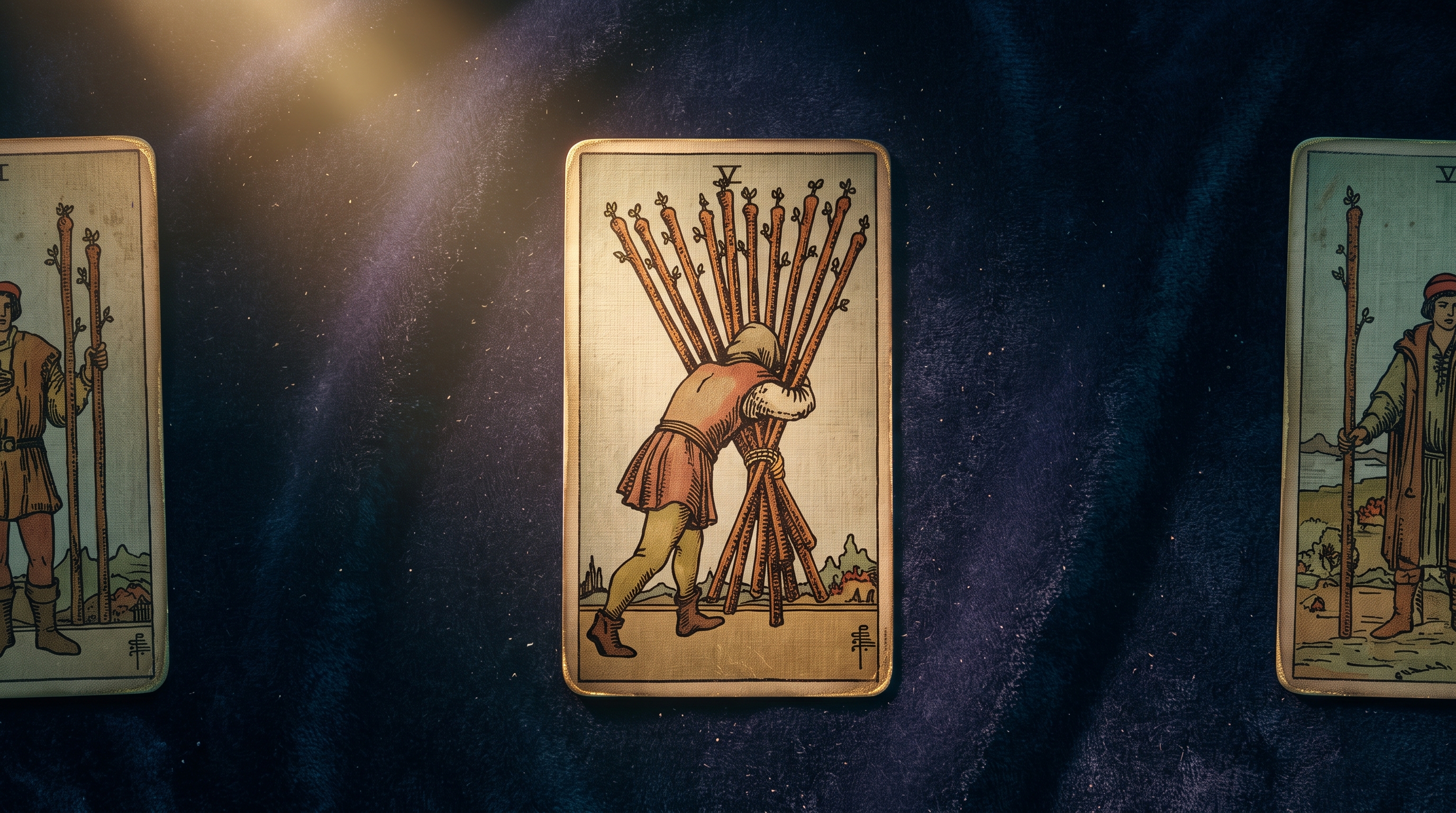
Lay three cards: what is genuinely mine, what was inherited, what can move. If the Ten of Wands appears in the second position, the workload conversation you have been avoiding is the only useful next step. The card rarely shows up in the third position without a name attached to it.
When to Put It Down: A Tarot Reading Decision Framework
The Ten of Wands in a career reading is not asking whether you are capable of carrying it. It is asking whether carrying it still serves anything. Three questions separate a heavy season from a structural problem. Dive deeper with the mars 10th house career burnout.
The three-question test
- Could a colleague do this after a short handover? If yes, the task is delegable and the obstacle is permission, not skill.
- Is this keeping you visible or keeping you safe? Work used as job security is the hardest kind to set down, because setting it down feels like exposure.
- If you stopped doing it quietly, would anyone notice? If nobody would, it is invisible labour and it needs a name rather than an apology.
What the answers tell you
Two or more "no" answers point to a genuine capacity limit: the fix is scope, sequencing, or a plan to leave. Anything else points to a distribution problem, and distribution problems get worse when you try to solve them with personal efficiency. The core tarot guide is useful here if you want to trace how other cards in the suit handle the same transition.
The sentence that does the work
Vague refusals get ignored; specific ones get negotiated. Something like "I can't take this on this week — which of my current pieces should move?" forces a choice without drama and gives the other person a role in the outcome.
Paired Cards and Reversals: How to Read Tarot Combinations
A single card is a starting point. Pairs change the verdict, and the combinations below cover most work readings where this card appears.
| Paired card | What it adds | Practical read |
|---|---|---|
| Two of Wands | A decision already made | You are carrying a plan, not just a job |
| Three of Wands | Waiting on results elsewhere | The overload is short-term; don't restructure your life over it |
| Eight of Wands | Speed and deadlines | The heavy patch has an end date; decide what happens after it |
| Nine of Wands | Defensiveness | You are guarding territory, not only completing tasks |
| Five of Pentacles | Money fear | You keep the load because losing the income looks worse |
| The Hermit | Withdrawal | Solitude is shifting from pressure into preference |
When the reversal changes the advice
Reversed advice cards flip the instruction. A reversed Ten of Wands beside the Eight of Wands often means you have stopped caring about quality and are racing to finish; beside the Hermit it can mean you have quietly stopped telling anyone what you are doing.
What to watch for
If the same pair appears twice within a short period, treat it as confirmation rather than coincidence. Repetition is how a pattern stops being a rumour.
Contrast with the Ace of Wands
The Ace gives the opposite instruction: pick up one thing at a time, and pick it because it interests you rather than because it is unclaimed. When the Ace and the Ten appear in the same spread, the reading is usually about whether the work you are carrying still belongs to the version of you who started it. Dive deeper with the Angel Numbers.
Career Burnout Recovery: A Practical Unload Sequence
Make the bundle countable
A bundle is ten decisions pretending to be one feeling. Write every recurring task on its own line, and beside each one write either a name or the word "mine." The lines you never agreed to are the ones to move first.
Transfer before you optimise
Hand off the piece with the shortest learning curve. Early, visible wins make the rest of the conversation credible in a way that a well-argued case never does.
Let something be late
If you absorb every slip, the system receives no signal that it is broken — and your exhaustion is not a signal anyone else can read. Missing an internal deadline on purpose, with warning given beforehand, converts a private problem into a shared one.
Track what actually happens
Weekly, note which tasks still land on your desk and which ones stayed where you put them. If nothing changed after a genuine handoff, you are dealing with a culture problem rather than a workload problem, and that is a different decision entirely. For more on this, see the draw a tarot card.
Read it again later
Draw a single card each week with a free tarot draw tool and compare it with the Ten of Wands. The card is a snapshot of a posture, and a clear week-to-week sequence tells you whether you are actually putting things down or only describing it.
If the same card keeps returning and the handoffs keep stalling, a fuller tarot reading that maps the whole situation rather than a single card is a faster way to see the structure you keep re-entering. The card is not a diagnosis of your job. It is a description of your grip — and grips loosen one staff at a time, deliberately, while the town is still in sight.